


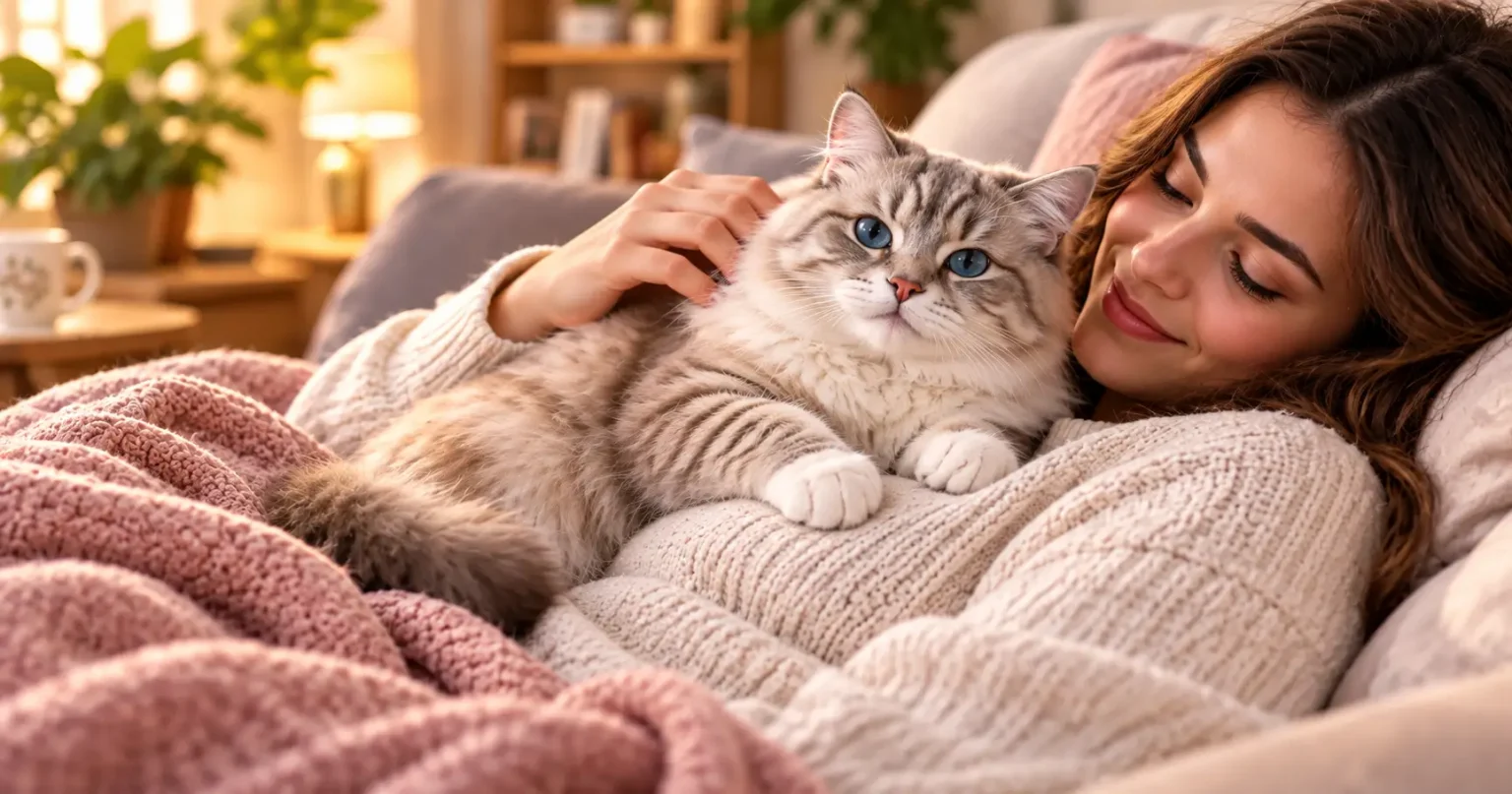
There is something oddly flattering about sitting down on the couch and having your cat immediately climb onto your lap. Your cat may have a perfectly comfortable bed nearby, a soft blanket, a sunny windowsill, or an entire sofa available, yet somehow you become the preferred resting place. This naturally leads many cat owners to wonder, why does my cat sit on me?
In most cases, the answer is not complicated. Cats often sit on their owners because they feel comfortable, safe, warm, and connected to them. Your body provides heat, your scent is familiar, and your presence can make your cat feel secure while it relaxes. For some cats, sitting on a person is also a way to request attention or simply spend time with someone they trust.
However, cats are individuals, so the exact reason can vary. One cat may climb onto your lap because it wants affection, while another may primarily be looking for warmth. Some cats sit on their owners because they have learned that doing so results in petting, while others simply enjoy the physical comfort of being close to a familiar person.
Understanding the behavior becomes easier when you pay attention to what your cat does before, during, and after sitting on you.
Why Does My Cat Sit on Me?

The simplest explanation is that your cat has decided that you are a comfortable place to rest. Cats can be selective about where they sleep and relax, so choosing your lap, chest, legs, or even your stomach can tell you something about how comfortable they feel around you.
Several reasons can happen at the same time. Your cat may enjoy your warmth while also feeling safe around you and enjoying the attention it receives. Veterinary-reviewed explanations of lap-sitting commonly include affection, warmth, security, comfort, scent, and social interaction.
That means there is not necessarily one secret meaning behind the behavior. Instead, sitting on you is often the result of several positive associations your cat has developed with you.
Your Cat May Feel Safe With You
One of the most important reasons cats choose to rest on people is security.
Sleeping and deeply relaxing leave an animal less prepared to respond quickly to its surroundings. A cat therefore tends to prefer places where it feels comfortable enough to lower its guard. If your cat repeatedly chooses your lap or body as a sleeping location, your presence may have become associated with safety.
This is particularly noticeable when a cat settles down, closes its eyes, stretches out, and begins purring. Those behaviors can indicate that the cat is relaxed rather than preparing to move away.
Your cat may also choose you when something in the environment makes it feel uncertain. Loud visitors, unfamiliar noises, other animals, or changes around the home can make some cats seek a familiar person. Sitting close to you can provide a predictable and reassuring environment.
This does not mean your cat consciously thinks of you as a human security guard. It simply means that your presence can become part of the environment in which the cat feels comfortable.
Your Body Is Warm
Sometimes the explanation is wonderfully simple: you are warm.
Cats naturally seek comfortable temperatures, and a human body can make an excellent source of warmth. Your lap, chest, or legs may be considerably more appealing than a cold floor or an empty chair.
This is one reason cats often seem especially interested in people when the weather becomes cooler. You may notice your cat looking for blankets, sunny areas, heated surfaces, or your lap during colder periods.
A cat does not necessarily choose you over a blanket because it has made an emotional statement. It may simply have discovered that your body is a particularly convenient warm place.
Of course, warmth and affection are not mutually exclusive. Your cat may genuinely love being around you while also appreciating the fact that you are basically a large, portable heating pad.
Your Cat Likes Your Scent
Cats have an extremely important relationship with smell. Familiar scents can help create a sense of familiarity and comfort.
Your cat encounters your scent throughout the home, on clothing, furniture, bedding, and other objects. Over time, your smell becomes part of the cat’s familiar environment. Sitting directly on you allows your cat to remain surrounded by something it recognizes.
This may help explain why some cats want to sleep on their owner’s clothes when the owner is away. The familiar smell can provide a connection to the person even when that person is not physically present.
When your cat sits on you, rubs its head against you, or settles against your clothing, scent and physical contact may both be involved.
Your Cat May Be Showing Affection
Cats do not always express affection in the same obvious ways that humans or dogs might. Some cats are extremely cuddly, while others prefer to remain nearby without actually being touched.
For a cat that enjoys physical contact, sitting on you can be a straightforward way of showing that it likes being around you.
Your cat may climb onto your lap, curl into a ball, purr, knead with its paws, and eventually fall asleep. These behaviors can create a relaxed social interaction between the cat and its owner.
Not every cat wants to be held or cuddled, however. Some cats demonstrate affection by simply sitting beside you, following you around the house, greeting you when you return, or choosing to stay in the same room.
So if your cat does not sit on you, that does not automatically mean it dislikes you.
Your Cat Has Learned That Sitting on You Gets Attention
Cats are excellent observers of routines.
If your cat jumps onto your lap and you immediately start petting it, talking to it, scratching its head, or giving it attention, your cat can learn that sitting on you produces a pleasant result.
Eventually, the behavior can become part of a routine.
Your cat may essentially discover:
“I sit here, and good things happen.”
That does not make the affection fake. It simply means cats can learn from repeated interactions. If sitting on your lap consistently results in attention, your cat may become even more likely to repeat the behavior.
This can also explain why some cats suddenly appear when their owner sits down. A standing person is difficult to use as a lap, while a person relaxing on the couch is a much more attractive opportunity.
Your Cat May Enjoy Your Company
Sometimes the reason is simply companionship.
Cats have individual personalities. Some are highly independent and spend much of the day doing their own thing. Others actively seek human interaction and prefer to remain close to their owners.
A cat that sits on you may simply enjoy being with you.
This is particularly easy to recognize if your cat follows you from room to room, waits near you, sleeps beside you, or comes over when you sit down. The lap may simply be the place where your cat gets the closest possible version of your company.
Research and veterinary discussion of cat-human relationships suggest that individual cats differ substantially in how much proximity and interaction they seek from their owners.
Your Cat May Be Marking You With Its Scent
Cats use scent as an important form of communication.
You may have noticed your cat rubbing its cheeks against furniture, doorways, your legs, or other objects. Cats have scent-producing glands around several areas of the body, and rubbing can help transfer familiar scent.
When your cat sits against you, rubs its head on you, or repeatedly presses its body against yours, scent marking may be part of the interaction.
It is sometimes described humorously as a cat “claiming” its human. While that phrase is entertaining, the behavior is better understood as part of normal feline scent communication and social familiarity.
Your cat is not necessarily declaring legal ownership of you. It is interacting with you using behaviors that are natural to cats.
Why Does My Cat Sit on My Chest?
Some cats prefer the chest over the lap.
There are several possible reasons. The chest is warm, elevated, and provides close physical contact. A cat lying on your chest may also be attracted to the rhythm of your breathing and heartbeat.
The movement of your breathing can be soothing to some cats. Your familiar scent is also strongest when the cat is very close to your face and upper body.
If your cat climbs onto your chest while you are lying down, it may simply have discovered that this is an especially comfortable place to relax.
Some cats will even knead with their front paws before settling down. Kneading is commonly associated with kittenhood and can occur during relaxed, comfortable interactions in adult cats.
Why Does My Cat Sit on My Lap?
The lap is almost perfectly designed for a cat.
It is warm, relatively soft, elevated above the floor, and usually stationary when you are sitting. If your cat already enjoys being around you, your lap combines several desirable features in one place.
Your cat may also associate your lap with predictable routines. Perhaps you sit in the same chair every evening, watch television, use your phone, read, or work at a desk.
Eventually, your cat may recognize the routine and decide that your lap is part of it.
This is why some cats appear almost immediately when their owners sit down. They have learned that a particular chair, time of day, or activity means an opportunity for comfortable contact.
Why Does My Cat Sit on Me and Then Bite Me?
This can be confusing.
A cat may climb onto your lap, purr, enjoy being stroked, and then suddenly nip your hand. That does not necessarily mean the cat stopped liking you.
Cats can become overstimulated by physical contact. Some enjoy petting for a while and then decide they have had enough. Their tolerance can vary depending on the individual cat, the location being touched, and the intensity or duration of the interaction.
Watch your cat’s body language.
Flattened ears, tail flicking, tense muscles, sudden skin twitching, or attempts to move away can indicate that your cat is becoming uncomfortable. Giving the cat space at that point can prevent a minor warning from becoming a stronger reaction.
A gentle nip can sometimes be a communication signal rather than an aggressive attack. The important thing is to consider the entire body-language picture rather than focusing only on the bite.
Why Does My Cat Sit on Me but Not Anyone Else?
If your cat consistently chooses you over other people, there may be several explanations.
Your cat may have formed a stronger bond with you because you feed it, play with it, provide care, or simply spend more time around it. Your voice, smell, movement, and handling style may also be particularly familiar.
Cats can develop clear preferences for individual people.
That does not necessarily mean the cat dislikes everyone else. It may simply feel most comfortable with one particular person.
Your cat may also have learned that you respond to its signals in a way it prefers. If you stop petting when it becomes uncomfortable, respect its space, and interact with it consistently, the cat may learn that being close to you is predictable and safe.
Why Does My Cat Sit on Me While I Sleep?
Sleeping is one of the most common times for cats to seek a comfortable resting location.
When you are asleep, you are usually relatively still for long periods. From your cat’s perspective, that can make you an excellent sleeping surface.
Your body is warm, your scent is familiar, and your movements may be predictable. If your cat already feels secure around you, lying on your bed or directly on you can become part of its nighttime routine.
Some cats prefer the feet or legs because those areas move less. Others choose the chest or even the area near the head because it provides warmth and close contact.
The exact position is largely an individual preference.
Does My Cat Sitting on Me Mean It Loves Me?
It can be a sign of affection and trust, but it is better not to reduce every cat behavior to a single human emotion.
Your cat sitting on you can indicate that it enjoys your company and feels comfortable around you. It can also mean your body is warm and convenient.
Usually, there is no need to choose only one explanation.
A cat can simultaneously enjoy your warmth, feel safe with you, like being petted, and want companionship. Cat behavior is often influenced by several motivations at once.
The strongest clue is the overall pattern. If your cat voluntarily approaches you, relaxes around you, seeks contact, purrs, sleeps near you, and appears comfortable, those behaviors collectively suggest that your cat has a positive relationship with you.
Why Doesn’t Every Cat Sit on Its Owner?
Not every cat is a lap cat.
Some cats love physical contact and will happily spend hours on their owner’s lap. Others prefer to sit beside the owner rather than directly on top of them. Some may enjoy being in the same room while maintaining several feet of personal space.
Personality plays a major role.
A cat’s early experiences, socialization, environment, age, and individual temperament can all influence how much physical contact it wants. Even cats from the same household can behave completely differently.
Therefore, it is not useful to judge the strength of a relationship solely by whether a cat sits on its owner.
A cat that sleeps on the other side of the sofa may still trust you deeply.
What If Your Cat Suddenly Starts Sitting on You More?
A sudden increase in clinginess is worth observing, particularly if it comes with other changes.
Cats can seek extra contact when the environment changes, such as after moving furniture, introducing a new pet, having visitors, or changing household routines.
However, behavior changes can sometimes accompany illness or discomfort. If increased attention-seeking occurs alongside changes in appetite, drinking, litter-box habits, energy, grooming, movement, breathing, or general behavior, it is sensible to speak with a veterinarian.
The important point is not to assume that increased affection automatically means something is wrong. A cat may simply become more cuddly for ordinary reasons. The surrounding symptoms and the cat’s overall behavior provide more useful information.
How Can You Tell Why Your Cat Is Sitting on You?
Pay attention to what happens around the behavior.
If your cat arrives when the room is cold, curls up tightly, and stays near you for warmth, temperature may be an important factor.
If your cat jumps onto you when you return home, purrs, rubs against you, and asks to be petted, social interaction and affection may be playing a larger role.
If your cat immediately falls asleep on you, it may primarily value comfort and security.
If your cat sits on you whenever you are holding its favorite blanket or sitting in its favorite chair, environmental comfort may be part of the attraction.
And if your cat sits on you regardless of the circumstances, you may simply have a very committed lap cat.
Should You Let Your Cat Sit on You?
If you enjoy it and your cat is comfortable, there is generally nothing wrong with allowing your cat to sit on you.
For many owners, these quiet moments become an important part of the human-cat relationship. You can use the time to gently pet your cat, talk to it, or simply allow it to sleep.
At the same time, respect your cat’s signals. Not every cat wants constant touching just because it has chosen to sit nearby.
Sometimes the best interaction is to let the cat settle down without disturbing it.
Giving cats control over when they approach and when they leave can help maintain positive interactions. If your cat gets up and walks away, there is no need to call it back or force it to stay.
Frequently Asked Questions
Why does my cat sit on me every time I sit down?
Your cat may have learned that your sitting routine creates a warm, comfortable place where it receives attention. Your lap may also be associated with relaxation and safety. If the behavior happens consistently, it may simply have become part of your cat’s routine.
Why does my cat sit on me instead of beside me?
Your cat may prefer the warmth and physical contact of sitting directly on you. Some cats enjoy close contact more than others, particularly when they are relaxed or sleepy.
Does my cat sitting on me mean it trusts me?
Often, yes. Choosing to relax on your body can indicate that your cat feels comfortable and secure around you. However, individual cats show trust in different ways.
Why does my cat sit on me at night?
Your body is warm and familiar, and you may remain relatively still while sleeping. Your cat may also enjoy being close to you during a quiet period when the home is less active.
Why does my cat sit on me and purr?
Purring commonly occurs during relaxed and pleasant interactions, although purring can have different meanings depending on the situation. If your cat is relaxed, comfortable, and showing other positive body-language signals, the purring likely accompanies a pleasant interaction.
Why does my cat sit on me but not my partner?
Cats can develop individual preferences. Your cat may be more familiar with your scent, routine, voice, or handling style, or it may simply have formed a stronger social bond with you.
Is it normal if my cat never sits on me?
Yes. Some cats are affectionate without being lap cats. Sitting nearby, following you, rubbing against you, greeting you, or choosing to stay in the same room can also be signs of social attachment.
Why does my cat sit on my chest?
Your chest provides warmth and close physical contact. Your breathing, heartbeat, and familiar scent may also make the location appealing. Some cats simply find the chest a comfortable place to sleep.
Final Thoughts
So, why does my cat sit on me? In many cases, it is because you provide a combination of things cats naturally value: warmth, comfort, familiarity, security, and companionship.
Your cat may be seeking affection, looking for a warm place to sleep, enjoying your scent, asking for attention, or simply following a routine it has developed. Often, several of these reasons overlap.
The most meaningful part is that your cat has decided that being close to you is worthwhile. Cats have plenty of places to rest, yet a lap can become their preferred spot because it combines physical comfort with a familiar social connection.
Whether your cat spends five minutes on your lap or refuses to move for three hours, its individual personality will determine how it expresses that relationship. And if your cat regularly climbs onto you, curls up, and falls asleep, you can probably take it as a pretty good compliment: for that moment, you are the most comfortable place in the house.
For More Visits: Can cats have almond milk Safe Guide 2026


