

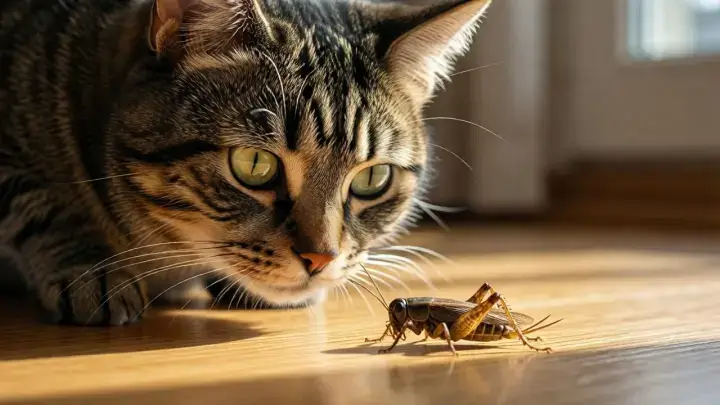
Cats are naturally curious animals. Anyone who has lived with a cat knows how quickly they react to moving insects, especially small creatures like crickets. Whether it is a cricket jumping across the floor or chirping at night, most cats show instant hunting behavior. This often leads pet owners to ask an important question: can cats eat crickets?
The short answer is yes, cats can eat crickets, but the real understanding lies in how safe it is, how much is appropriate, and what effects it may have on their health. Cats are obligate carnivores, meaning their bodies are designed to consume animal-based protein. Insects like crickets do contain protein, but that does not automatically make them an ideal or necessary food source.
This article takes a deep look into whether crickets are safe for cats, their nutritional value, possible risks, and how they fit into a cat’s natural diet.
Understanding a Cat’s Natural Diet
To understand whether crickets are suitable for cats, it is important to first understand what cats are biologically designed to eat. In the wild, cats survive by hunting small animals such as mice, birds, and insects. Their digestive system is highly specialized for animal protein.
Unlike omnivores, cats do not rely on plant material for nutrition. Their bodies require specific nutrients such as taurine, arachidonic acid, and vitamin A, which are found naturally in animal tissues.
This is why commercial cat food is formulated with meat-based ingredients. Even though cats may occasionally eat insects, these are not their primary nutritional source.
Crickets fall into the category of small insects that cats may naturally catch and consume, but they are more of an incidental snack than a dietary requirement.
Can Cats Eat Crickets Safely?
Yes, cats can eat crickets in most cases without serious harm, especially if the crickets are clean and have not been exposed to pesticides or chemicals. In fact, many cats enjoy chasing and eating insects as part of their instinctual hunting behavior.
However, safety depends on several factors. Wild crickets found outdoors may carry parasites, bacteria, or contaminants that could potentially affect a cat’s digestive system. Indoor-bred crickets, often used as feeder insects for reptiles, are generally safer because they are raised in controlled environments.
Even though crickets are not toxic to cats, they should not replace a balanced diet. They are only an occasional treat rather than a food staple.
Nutritional Value of Crickets for Cats
Crickets are often discussed as a “superfood” in human nutrition due to their protein content, and the same applies to some extent for animals. They contain protein, fat, fiber, and micronutrients such as iron and calcium.
For cats, protein is the most important nutrient, and crickets do provide a decent amount of it. However, the protein profile is not complete when compared to meat sources like chicken, fish, or beef.
Crickets also contain chitin, a fibrous material found in their exoskeleton. While small amounts are not harmful, excessive intake can be difficult for a cat’s digestive system to process.
Overall, crickets can provide nutritional value, but they are not nutritionally balanced enough to be a core food source for cats.
Why Cats Are Attracted to Crickets
The behavior of cats toward crickets is driven by instinct. Cats are natural hunters, and anything small, fast-moving, and unpredictable triggers their predatory response.
Crickets produce sound and movement, which immediately captures a cat’s attention. The jumping motion resembles prey behavior, making it irresistible for many cats to chase.
Even well-fed domestic cats will often hunt insects simply because it satisfies their instinct rather than their hunger. This is why a cat may ignore its food bowl but still chase a cricket across the room.
This behavior is completely normal and reflects their evolutionary background.
Potential Risks of Cats Eating Crickets
Although crickets are generally safe, there are some risks that pet owners should be aware of. The most common concern is contamination. Outdoor crickets may have been exposed to pesticides or harmful chemicals, which can affect a cat’s health if ingested.
Another risk is digestive discomfort. Some cats may experience mild stomach upset after eating insects, especially if they consume too many at once. Symptoms can include vomiting or loose stools, although this is usually temporary.
There is also a small risk of parasites. Wild insects can carry organisms that may affect pets, although this is less common in controlled environments.
In rare cases, a cat may have an allergic reaction to insect proteins, but this is not widely reported.
Are Crickets Better Than Commercial Cat Food?
Crickets should not be compared directly to commercial cat food because they serve entirely different nutritional roles. Cat food is specifically formulated to meet all dietary needs, including essential vitamins, minerals, and amino acids.
Crickets, on the other hand, are incomplete in terms of nutrition. They lack the balanced formulation that cats require for long-term health.
While crickets can be a natural snack, they cannot replace a complete diet. Feeding cats only insects would lead to nutritional deficiencies over time.
Should You Feed Crickets to Your Cat on Purpose?
In most cases, there is no need to intentionally feed crickets to cats. If a cat catches one occasionally, it is generally harmless. However, deliberately using crickets as a regular treat is not necessary.
Some pet owners experiment with insects as enrichment or natural play-based feeding, but this should always be done cautiously and in moderation.
If crickets are offered intentionally, they should be clean, pesticide-free, and sourced from safe environments. Even then, they should only be given occasionally rather than regularly.
Indoor vs Outdoor Crickets
The source of crickets matters significantly. Indoor-bred crickets raised for reptile feeding are usually safer because they are grown in controlled conditions without exposure to harmful chemicals.
Outdoor crickets, however, are unpredictable. They may have been exposed to pesticides, pollution, or parasites. Cats that hunt outdoors naturally encounter these risks, but pet owners should be more cautious when introducing insects directly.
Understanding the difference between safe and unsafe sources is important for responsible pet care.
Cats and Hunting Behavior: A Natural Instinct
Eating crickets is not just about nutrition; it is also about instinctual behavior. Cats are wired to hunt. Even domesticated cats that never go outside retain this instinct.
Chasing insects provides mental stimulation and physical activity. In some cases, it can even help reduce boredom in indoor cats.
However, allowing uncontrolled hunting of unknown insects is not always ideal. Controlled play and safe toys can replicate this behavior without risk.
When to Be Concerned
If a cat eats a cricket and shows no symptoms, there is usually no cause for concern. However, pet owners should monitor for unusual behavior such as repeated vomiting, lethargy, or loss of appetite after insect consumption.
If such symptoms appear, it is best to consult a veterinarian. While rare, these reactions should not be ignored.
Most cats handle occasional insect consumption without any issues, but individual sensitivity can vary.
Conclusion
So, can cats eat crickets? Yes, they can, and in most cases, it is not harmful. Crickets are not toxic to cats and may even provide some protein. However, they are not a necessary or complete food source.
Cats are natural hunters, and eating crickets is often driven by instinct rather than nutritional need. While occasional consumption is generally safe, crickets should never replace a balanced diet designed for feline health.
The safest approach is moderation. If a cat catches a cricket, it is usually harmless. But relying on insects as a food source is not recommended.
Understanding your cat’s natural behavior and nutritional needs ensures they stay healthy while still enjoying their instinctive curiosity.
FAQs
1. Can cats eat crickets safely?
Yes, cats can eat crickets in most cases without harm if the insects are clean and pesticide-free.
2. Are crickets good for cats?
They contain protein but are not a complete or balanced food source for cats.
3. What happens if a cat eats too many crickets?
It may cause mild stomach upset such as vomiting or diarrhea in some cases.
4. Are wild crickets safe for cats?
Wild crickets may carry chemicals or parasites, so they are not always safe.
5. Do cats like eating crickets?
Many cats enjoy chasing and eating them due to their natural hunting instinct.
6. Should crickets be a regular part of a cat’s diet?
No, they should only be an occasional treat, not a dietary staple.
For More Visits: Animalsinfo